THE GAME
This is an investigative role playing game focused on chasing rumors or traces of a supernatural monster, an anomaly, then tracking down and confronting it in a climactic and violent scene.
Player characters, called executioners, go on a hunt.
- One player will be the the Administrator (Admin), who will set up the story and location of the hunts, play all the NPCs, decide the location and set the scenes, and play the antagonist, the Anomaly.
- Anomalies are extremely dangerous and violent beings easily capable of pulverizing a human with their numerous superhuman abilities. However, they are born out of human traumas and uncovering and unraveling the mysteries surrounding their birth can help to weaken them.
- Executioners have limited time to locate and execute an anomaly before its growing power causes the situation to spiral out of control.
- After a session is over, players reflect on the session and their characters may gain experience and improve.
- After a hunt is over, executioners (if they survived) will get paid and have a chance to increase in rank.
So it goes.
MATERIALS
If playing in person, players will need character sheets, some paper and pencils for tracking information, and a number of 6 sided dice (d6s). They may also need small note cards or post it notes for note taking or tracking effects. The Admin will need one or two d6s, post it notes or notecards, and a hunt sheet.
Sometimes this game will ask you to roll 1d3. This is just a d6 with the numbers halved and rounded up (1-2: 1, 3-4: 2, 5-6: 3)
PLAY
CAIN is played, like many other role playing games, as a collaborative story told between the players: the executioners and the Admin. The executioners play the main characters and choose their course of action, while the admin plays and describes the world, non-player characters (NPCs), and adversaries.
The basic flow of the game should go like this:
- The Admin sets the scene and describes details. Then, they turn the action over to the players. What do the players do?
- The players describe or role-play their course of action, answering that question, and moving the story forward.
- The Admin responds to their course of action, then turns things back over to the players. What do you do?
TAKING ACTION
To do most things in this game, just do it. Most actions in this game won’t require rolling dice However, if the outcome of a character’s action is risky, contested, or unclear, a character states their intent and makes an action roll.
THE ACTION ROLL
To make an action roll, a player rolls a number of d6s (six sided dice, also written as D, like +2D), assembled the following way:
- Add up to 3d6 for a character’s skill in an action. Skills describe how good a character is in general at a type of activity, like physical fitness or investigation. They go from 0-3, with level 3 skills being exceptionally rare.
- Add up to 3d6 for advantages. This could come from aid from an ally, situational bonuses, or a character’s abilities.
- If a dice pool is 0 dice, you instead roll 2d6 and pick the lowest result instead. Dice pools can’t go below 0 for any reason.
Then roll all dice. Any die rolled of 4+ is a success. Action rolls with at least one success accomplish their goal. You may be able to cash in extra successes in certain circumstances.
If you don’t get at least one success, you fail, and suffer the consequences.
When to Roll
Only roll if a character’s action is risky, contested, or unclear. Rolls should be reserved for tense or dramatic moments in the game where the action could take a turn, important information could be revealed, or the situation could change suddenly. If the outcome wouldn’t be any of these, don’t roll for it, just move the story forward. Ultimately, the Admin always decides when a roll is necessary. Characters should generally make one roll for most tasks, and can’t re-attempt the same task unless the situation or context changes significantly
JUDGING A ROLL
When a character states their intention with an action roll, the Admin must judge if that action is hard or risky. This is up to the Admin and the character is always able to ‘back out’ of a roll and renegotiate based on the situation.
HARD
Hard is very simple. If an action is judged to be hard, a character only scores successes on a 6.
The Admin may judge a task to be hard if it the approach is beyond a character’s typical capabilities, if they are under duress or in a bad situation, or they don’t have the appropriate resources (tools, information, etc.) to tackle a task.
Situations that might be hard:
- Trying to fight blind.
- Rushing someone with a gun and trying to disarm them unarmed.
- Jumping an especially large gap between buildings.
- Trying to talk your way out of an active arrest.
- Sneaking past a security guard in broad daylight.
- Conducting research on a blood sample without appropriate tools.
- Trying to fight while hanging off the side of a building.
IMPOSSIBLE
The Admin is always able to say a roll is impossible given the circumstances. Players can always change this by changing these circumstances - using tools, abilities, or resources they have available to them. Executioner capabilities are about that of an average well trained human - but their powers are not, and can push far beyond what is possible for a person to accomplish.
RISKY
An action is risky if the situation is tense and there is some significant and clear consequence, complication, or danger that could result from a character’s action. On a risky action, the Admin also makes a roll, called the risk roll.
This is a 1d6 roll, made at the same time as the action roll. The Admin makes the risk roll then checks the result of the risk die, using the result to determine the consequences or outcomes for a character’s actions, with the lower the result, the worse the outcome, and vice versa.
- On a 4/5, the outcome or consequence is about as expected, success or failure, with no further complications.
- On a 2/3, it’s worse than expected. Consequences might be a little worse, actions a little less effective or more complicated, even on a success.
- On a 6, it’s better than expected - the action is more effective, has lighter consequences, or reveals a sudden opportunity.
- On a 1, it’s much worse than expected - the worst thing that could happen happens.
Here’s a simple table:
- 1: Much Worse
- 2/3: Worse
- 4/5: Expected
- 6: Better
This happens regardless of the action’s success or failure, and means that on a 1-3, characters can take consequences or complications from a risky roll even if their action is successful.
This is generally the only time the Admin should roll other than a fate roll.
STRAIGHT ROLLS
Not all action rolls are risky. If there is no clear and present consequence or danger, there’s no risk involved and the roll is a straight roll without the risk die being rolled at all. A player might make straight rolls when:
- Making general tests of ability, knowledge, or skill.
- Investigating, surveying, or exploring.
- Persuading someone who has a receptive attitude.
- Working on a project.
- Taking action where the result is unclear but the outcome isn’t necessarily dangerous, like trying to hotwire a car or pick a lock.
ADMIN ROLLS
The Admin almost never rolls in this game - instead they respond to player rolls with straightforward outcomes in each situation based on the players’ actions, approach, and the situation of the story.
Initiative in CAIN is usually with the players, with the Admin playing reactively and always turning the story back to the players to ask them what they do next.
However, the Admin doesn’t always have to play off of failures, and can move situations forward even if players are rolling successes. They can always present executioners with a new opportunity or situation, for example by:
- Progressing a situation or moving time forward.
- Introducing a complication or changing up the situation.
- Presenting executioners with a choice.
- Threatening executioners with something.
FATE ROLLS
If the Admin does want to leave something up to chance, they can make a fate roll, rolling a 1d6.
- 1: Poorest result
- 2-3: Poor result
- 4-5: Good result
- 6: Best result
For example:
- Is this cultist armed?
- Is this person alive when the players reach the scene?
- How much time is left before the fire collapses the building supports?
- What’s this person’s attitude towards the executioners?
- Will the cultists’ morale break and will they flee?
And so on.
Circumstances Matter
Risk and difficulty, or whether a roll is even possible, are mostly circumstantial. A roll that might be hard or impossible might become much easier, or not even be a roll at all if characters have a tool, use an ability, or use teamwork.
CONSEQUENCES
When player characters fail a roll or take a risky action and the risk die rolls low, the Admin can impose consequences or complications. These can never take away success (for example, rolling low on the risk die if the action was a success), but can add complications or costs to an otherwise successful roll. Admins can:
- Force the the executioners to pay a cost:
- In attention (an executioner is preoccupied for a while, or misses something important)
- Effectiveness (someone else needs to follow up to finish the job, slash a tag one less time)
- Gear (tools or weapons break or jam, supplies or ammo are used up)
- Safety (the situation gets more risky)
- Time (miss opportunities, degrade situations)
- Threaten an executioner with more severe consequences unless further action is taken.
- Cut off an opportunity: a door closes, an NPC isn’t cooperative, someone gets away.
- Separate an executioner.
- Force an executioner to make a hard choice (dropping their ally off a building or saving their own skin).
- Hinder an executioner - make something harder for them until they can change the situation.
- Give a hook: Give a hook to an executioner.
- Start a ticking clock - Set out a tag with negative consequences, or slash an existing tag this way.
- Look to the characters, the anomaly, or the hunt. Many of them have existing abilities or details on their sheets that can be used as inspiration to inflict consequences. Anomalies even have a reaction list they can use in conflict scenes that give explicit outcomes.
Admins can also improvise consequences based on the situation and the executioners approach, and the intent of the player, not just what is listed here. The admin can always refer to the risk die when determining their severity if the action was risky.
Harming the executioner should always be established, i.e. executioners should never take harm unless harm was already established as a clear and present consequence. Generally executioners are only hurt when an activity is risky or there is clear danger. The amount of stress an executioner takes depends on the situation and what is threatening them.
UPSIDES
Sometimes executioners will roll a 6 on a risk roll, giving them a small chance to swing the situation back in their favor, even on a failure. This can be as simple as:
- Their action is more effective, or has an effect even if they fail. If it’s on a tag, slash it an extra time.
- They gain insight, an opening or a better position with their action, making their next action less risky, less hard, or giving it +1 advantage die.
IMPROVING A ROLL
Generally the dice you roll come from skills. However advantage dice are very useful as they are ‘free’ and can most commonly be gained from the following sources:
- Mental Burst : A character can spend a mental burst, a limited resource, to use their powers and grant +1D on any roll if they can explain how they are using their powers in a creative way to help the situation.
- Setup: A character may set up themselves or another character for +1D
- Abilities: Many character abilities give +1D in certain circumstances.
- Circumstance: The Admin is free to give out +1D for any circumstantial bonus they see fit.
No matter how many dice a character gains from these sources, they can’t gain more than +3D in advantages.
These same situations can also be used by the Admin to determine whether a roll is hard, risky, or even necessary, so it’s up to the Admin where to apply these bonuses.
TEAMWORK AND SETUP
Characters can work together in two main ways, teamwork and setup.
TEAMWORK
When rolling, if multiple characters are able and willing to work together, you can choose a leader, then combine the highest of advantages, skills, kit and abilities among those characters. The leader then makes the roll, and the consequences and outcomes of the roll then apply to all characters involved
Fact: Working together is agood way for executioners to survive a mission, so CAIN highly encourages you to sort out your differences.
For example: three characters are trying to climb a wall. One character has 3 in conditioning, and another has only 1 in conditioning but owns a grappling hook. The combined dice pool would be 3, and the grappling hook could help bring the roll down from a hard roll to a regular roll, or perhaps make it so there’s no roll at all!
Teamwork allows characters to pool their resources and make one roll or take one action to move a large number of people through a situation without having each individually roll. However, everyone takes the same consequences from an action (including stress suffered) which could make teamwork rolls a risky venture.
SETUP
A character can always take action to set up another character, including themselves. Examples of this:
- Causing a distraction so another executioner can slip by a guard.
- Giving a character a boost to get to a high vantage point.
- Providing covering fire.
Setup rolls can be hard or risky as normal. The action must always be taken with the intent and outcome of setting up another character, and has no other effect by itself. Characters can still suffer consequences from it.
On success, setup can give one of the following on the target’s next action that follows the opening made for them:
- +1D
- Decrease difficulty (hard > normal)
- Decrease risk (risky > straight)
A character can only benefit from setup once per action.
EXTREME AGONY
There is one final way to improve a roll. Executioners naturally accrue pathos, powerful negative energy that builds up from failure, regret, and physical suffering.
In any scene, an executioner gains 1 pathos whenever:
- They make a roll with no successes.
- They take an injury or affliction.
- They fill out a hook.
- Another executioner dies or suffers strain overflow.
Pathos can be stacked up to 3. More details on hooks, injuries, tags, an strain overflow can be found in 3. THE EXECUTIONER
TAGS
Sometimes actions are more complicated and can’t be solved in one roll. In this case, this game makes use of tags, simple trackers that represent these more complex challenges.
When rolling on a tag, make action rolls with the same parameters (dice pool, consequences, risky/hard), but then cash in all successes, making 1 slash on the tag for each success.
- For example, a character rolls 2d6 for their action and gets a 4, 6. They would get two slashes. If the action was hard, they would only get one.
Tags fill up and resolve when a certain number of slashes are completed. The longer a tag, the longer the complexity of the task involved. You usually write this at the top of the tag.
- Simple tags are typically 1 or 2 segments
- Medium are 3-5
- Complex are 6-8
When a tag fills up, whatever it represents its resolved. Rolls that don’t fill up a tag represent partial progress on a task. “You’ve taken out a few guards, but there’s a few left”. “You’ve decrypted half the files, but there’s still a lot left, and the self-destruct timer is ticking.”
- Not all tags track tasks. Some tags can fill up by rolling, some fill up on their own, some track success states, and some track failure states. There’s more on tags in 3. THE EXECUTIONER.
- Tags should typically be set out as needed - in other words, when approaching a complicated task, don’t make a tag for it until the characters are able to describe their actions and approach. Circumstances can make tags much shorter or longer!
- Tags shouldn’t be proscriptive but descriptive. It’s better to set out a Tag named ‘Shuddering Horrors’ than ‘Evade the Shuddering Horrors’.
- Characters might make more or less slashes on on a tag due to the situation. Slashes can be reduced to 0.
SLASH AND SLASH AND SLASH UNTIL IT IS DONE
CATERGORY
Anomalies are powerful supernatural forces, and Executioners the weapons used to combat them. Anomalies may easily surpass human limits. Unfortunately, Executioners are limited by the general limits of human capabilities.
However their powers, Defiance, are not.
Much like natural disasters, both anomalies and executioners are rated by Category, generally indicating their power, usually written as CAT. As each increase in category, the speed, scale, and strength of their capabilities increase drastically.
- Category goes from 0-7, with Category 0 being general human capabilities. Anything mundane an executioner does is usually at CAT 0.
- Executioners’ themselves are rated from category 1 to 5, but can sometimes push past CAT 5. This describes the capabilities of their powers.
Fact: 40% of executioners do not survive long enough to be rated CAT 3.
Fact: Category 7 Anomalies, if they existed, would be considered major world events. According to SEER archive, there is no historical record of any Anomaly reaching Category 7.
MUNDANE VS SUPERNATURAL
Anything mundane an executioner does to try and harm or subdue a supernatural force such as an anomaly is always hard, no matter what. Their capabilities and equipment are the general capabilities of a (well trained) human, usually rated at CAT 0.
However, their supernatural powers are able to surpass this limit: an executioner’s defiance increase in category with them.
USING CATERGORY
Category determines the general size, strength, and scale of things in fictional terms. For example:
- A car versus a 16 wheeler freight truck.
- A couple humans versus a whole crowd of humans.
- A shack versus a skyscraper.
- A handgun versus a bazooka.
The Admin can use the category of something to figure out whether:
- A roll is hard or risky for a character. A roll is typically hard or risky if the target of a power is higher category. Conversely, a roll can be less risky or hard if the target of a power is of a lower category.
- A roll is impossible for a character given their current capabilities. For example, a character that can lift objects with their powers and is Category 4 could easily lift a car (CAT 3), but would probably find it impossible to lift a skyscraper (CAT 7). Generally tasks that are three or more categories higher than an actor are impossible for them.
- A roll is even required for a task, typically if it’s three or more categories lower. For example, an executioner throwing a building at a single mundane human probably wouldn’t have to roll at all to crush them like an insect.
- A character can do something beyond human capabilities, and to what extent.
These capabilities are usually listed out in short form in each power entry.
You’ll note this means executioner’s basic mundane abilities and gear become totally ineffective against anomalies of CAT 3+. This can be bypassed with better gear (an executioners weapons can be upgraded) or a little creativity. Hitting an anomaly with a mundane force is always hard, but still possible. You could hit a CAT 4 anomaly with a train for example, and it would still hurt.
CATERGORY TABLE
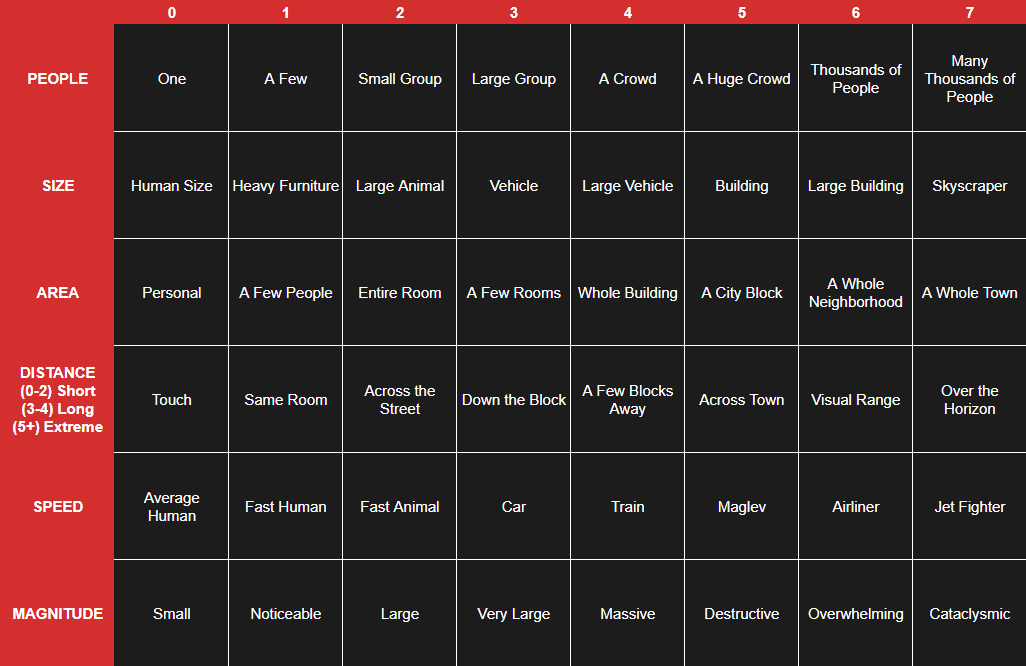
Use CAT 0 when describing general human or mundane capabilities.
Well trained humans can sometimes reach CAT 1.
Higher CAT effects vs lower CAT targets are more effective and may not even require a roll if they are 3 or more lower.
Lower CAT effects vs higher CAT targets are less effective, more risky, or harder, and may be impossible if they are 3 or more higher.