THE HUNT
This game is played as a series of hunts. Each hunt may take one or more sessions.
Activities pursued during a hunt might require a single roll or might require a tag to track progress. they might take a single scene or roll or might take a couple scenes - it’s up to the approach the executioners take and the judgement of the Admin.
Hunts have the following basic format:
- Executioners have a briefing about the upcoming hunt.
- Executioners arrive on the scene. They always arrive in good shape: full stress, no injuries, no hooks, 3 mental bursts, max kit points. Essentially, each mission is a ‘reset’ for them. The only thing that carries over for them is agendas, strain level, strain marks, and their own abilities, experience, and scrip.
- The goal of every hunt is to track down a anomalies’ refuge - it’s palace - where it can be permanently destroyed.
- However, executioners may want to reach their goal with all the advantages they can get. By investigating the circumstances of the anomalies’ birth - it’s traumas, they may be able to weaken it. They may want to prepare to give themselves advantages. Lastly, they may need to rest to recover their strength.
- While executioners are investigating and tracking the anomaly, the situation continues to evolve. This is tracked by the Admin with the tension tag and a pressure tag. The tension tag ticks up as executioners take action and introduces new complications or consequences. The pressure tag ticks up whenever the tension tag fills up and represents the overall degrading situation. If the pressure tag fills up completely, the situation goes out of control and things get much worse, so the executioners are on a timer.
- During a hunt, the players might get into conflict scenes when the stakes get high. If they fight an anomaly outside its palace, it may always retreat there to recuperate. Once inside an anomalies’ palace, the executioners can summon it back there to cause an execution scene where the anomaly may be permanently destroyed or dealt with.
- Exfiltration: The executioners leave the scene. If the executioners survive, they are paid in scrip and mark a mission survived. They then halve all strain.
At the end of every session, executioners will get experience based on their activities and agendas.
I. BREIFING
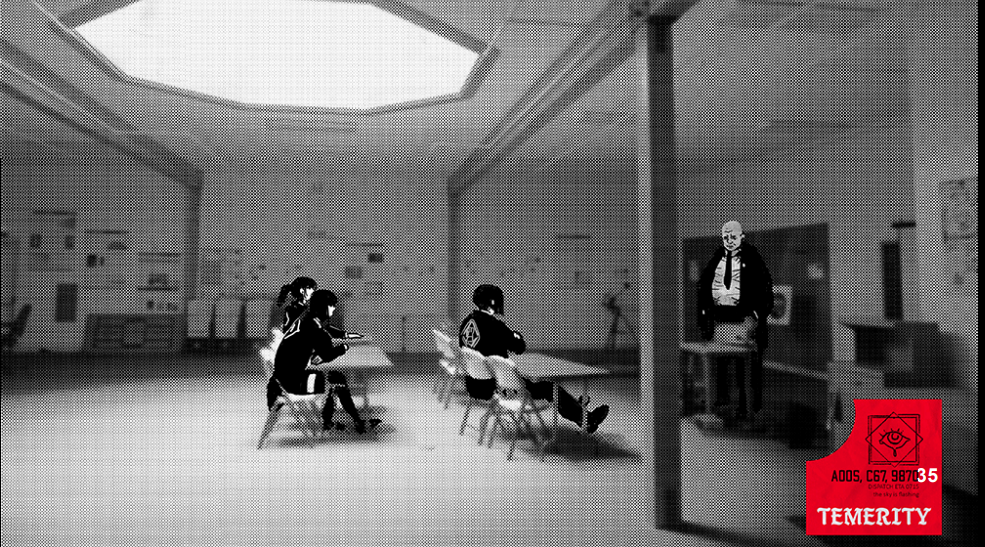
The hunt always starts with a briefing. These nominally should take place in some kind of comfortable or formal location. CAIN has sanctioned office facilities all over the world but executioners are encouraged to improvise for the sake of expediency and executioners have been known to take briefings in train cars, private cafe booths, or even fast food restaurants. A briefing scene never increases tension.
The person giving the briefing goes over the broad details of the case, the location, and the points of interest. This person doesn’t necessarily have to be an NPC but could be a player character going over materials received from CAIN. Due to the rapid, secretive, and extremely time sensitive nature of their activities, executioners are faced with multiple problems:
- First, the only thing executioners know about the anomaly is its basic type and its trauma questions. They also know basic information about the inciting incident that prompted their appearance, such as clues or characters involved. The rest of the Anomaly sheet, including its powers, history, and abilities, is unrevealed.
- Second, CAIN is a clandestine organization. It never starts with the cooperation of local authorities, who executioners must work around, suppress, control, or avoid, lest they reveal the true nature of their activities.
- Third, and finally, the executioners deploy only with what is in their kit.
You may note reading ahead that for junior executioners, that means no id, no transportation, no cell phone, no money, and no comfortable shoes. So it goes.
POINTS OF INTEREST
The Admin should lay out all the points of interest for the investigation area. These are locations, details, and people involved in the investigation. The Admin may choose to keep some of these secret but should present at least 2-3 to the executioners at the start. These are typically things that kicked off the investigation in the first place - hooks like a murder scene, a sighting of something supernatural, a suspicious individual, or a mysterious disappearance. For more details on this see 10. RUNNING CAIN.
II. ARRIVAL
After the briefing, the executioners arrive on the scene. It is traditional for them to arrive in CAIN black helicopters or armored cars but public transit can also make an appearance.
Executioners that arrive have a ‘full refresh’ of sorts. They always start with full stress, no injuries, no hooks, 3 mental bursts, and all their kit points.
The only burden an executioner carries from mission-to-mission is their current level of strain (after halving at mission end).
III. TRACKING
All anomalies create a warped pocket reality called a palace, a kind of lair where the world has twisted to accommodate it. Tracking the anomaly down to its palace, and tracking down the anomalies’ host, is one of the main purposes of the executioners’ mission. A palace is always nearby where the anomaly is most active, and is always inside the investigation area.
Executioners that track an anomaly might:
- Use their superhuman abilities to sniff out its traces and stain.
- Try to search for evidence of its palace in the environment.
- Follow clues based on its victims.
- Pull on social connections that its host has.
- Track down its host, and whatever state they are in.
A palace is a parasitic extra-dimensional space and its inside may not conform to the rules of mundane reality. Its entrance can be invisible to mundane humans, and is often hidden in plain sight. Its appearance inside often reflects the psyche of the anomaly and its host.
Tracking an anomalies’ palace down is important, since if fought outside of its palace, an anomaly may slip away there when injured there to heal and recuperate - it is impossible to slay it permanently outside. If slain outside, the anomaly retreats into its palace and regenerates, and is trapped there until pressure increases.
If an anomaly is fought inside of its palace, however, it can be fully destroyed and has nowhere to retreat to. This forces an execution scene.
Executioners that enter an anomalies’ palace can forcibly summon it there if it is outside. All executioners are able to use a psychic pulse that forces an anomaly back into its palace. To use it, however, they need one of the following:
- The physical presence of the anomalies’ host.
- An object or person precious to the anomalies’ host.
- A part of the anomalies’ hosts’ body, even deceased.
Otherwise, brave executioners can confront and fight an anomaly outside of its palace and force it there. Executioners that successfully track down an anomalies’ palace may not want to rush off to fight it however, as unprepared executioners are usually dead executioners.
IV (A). INVESTIGATION
Aside from tracking the anomaly, executioners may want to take time to gather information. The main purpose of this is to investigate the anomalies’ capabilities or its traumas.
Investigating may take only a few rolls to make progress, but depending on the executioners’ approach, the goal of the executioners’ activities, and the complexity of gathering information, the Admin can set out a tag to roll on.
Executioners that investigate might:
- Examine the anomalies’ victims.
- Observe or attempt to communicate with the anomaly.
- Examine crime scenes or traces of the anomaly.
- Gather information from witnesses or contacts.
- Perform experiments or research.
TRAUMAS
All anomalies have traumas, events that have precipitated their birth from their host. When making an anomaly, the Admin answers the anomalies trauma questions and establishes traumas based on the answers. In essence, traumas are at the center of the human tragedy that forms the core of hunts.
Executioners start a hunt knowing the anomalies’ type, and therefore its trauma questions (but not the answers).
COUNTERING
If they are able to investigate and uncover traumas by discovering their answers, when executioners fight the anomaly in an execution scene and the anomaly reacts to their actions, they can use each answer to counter an anomalies’ reaction.
Executioners must use a counter after seeing the result of the risk die but before the Admin announces a reaction.
Then, roll 1d3. Reduce any stress suffered by one target by the amount on the die, and the anomaly immediately takes that many slashes on its execution clock from the psychic trauma, which cannot reduce it below 1.
Executioners that counter an anomalies’ reaction may:
- Make appeals to its humanity.
- Throw it off guard with sensitive information.
- Enrage or distract it.
- Reveal a weakness.
Each question can only be used once!
IV (B). PREPERATION
Executioners may want to make preparations to confront the anomaly or constructing defenses against its domains.
Executioners can either prepare countermeasures against anomalies’ powers, work on assets to help them fight or track down the anomaly, or they can work on any other projects that will take time to prepare.
For Example:
- Writing tags to counteract against an anomalies’ power.
- Preparing a trap.
- Crafting improvised explosives.
- Trying to convince civilians to leave the area.
- Drawing a protective circle around a character.
- Locating a working car.
In some cases, preparing may only take a single action roll, but for more lengthy or ambitious projects, the Admin should set out a tag to roll on.
IV (C). REST
Executioners that rest are recovering and letting time pass.
The executioners must decide to rest as a group. If they do, pressure always increases by 1.
Each executioner rolls 2d3, then takes each die and assigns it to an item from the following list. They are able to make the same choice twice.
- Regain that many mental bursts.
- Recover stress equal to the d3.
- Erase slashes on a hook equal to the d3.
Resting also ends the effects of some powers and abilities, or resets others.
Companionship is a valuable comfort, and should be cultivated to an extent. Even so, CASTLE does not encourage relations between executioners to exceed dormitory standards. Emotional regulation is of utmost importance to the health and well being of CAIN’s stable assets.
Thank you for your understanding!
V (A). TENSION
At the start of the hunt, the Admin will set out a tension tag, visible to everyone. Tension increases when:
- A scene passes.
- A ‘1’ result is rolled on a risk die, but no more than once a scene.
Not all executioner activities can take a scene - some can be rolled in the background of other scenes, like preparation activities. If a scene is especially short, the Admin might not count it.
However, the general rule is whenever a scene passes, tension is ticked up. Each time the tension tag goes to 3 slashes, empty it. Then the Admin increases the pressure tag (see below) by 1 and picks a tension move to activate.
Tension moves often improve a anomalies’ position, impede or harm the executioners, or have some other deleterious effect on the world.
Tension never increases during a conflict scene or a briefing scene.
V (B). PRESSURE
Each anomaly has a unique way that it affects or warps the world around it. This effect gets worse and worse the longer time goes on.
At the start of a hunt, the Admin will set out a pressure tag, visible to everyone, with a capacity of 6. As the tag fills up, the situation degrades, in a way unique to each anomaly.
Pressure increases by 1 when executioners rest, and when the tension tag fills up.
The anomalies’ execution tag increases by 1 for each tick on pressure. Additionally, if the pressure tag fills up completely and would be notched further, the situation gets out of control. The effects of this are noted in each anomalies’ pressure description.
VI. EXECUTION
Each anomaly has an execution tag. Broadly speaking, the execution tag determines how the anomaly functions in a conflict scene. It also gives the executioners a tag to roll against when going up against the anomaly in a conflict situation. It’s the lifeblood of the anomaly - when executioners attack or otherwise attempt to take action to harm or defeat the anomaly, it’s this tag that fills up. The tag is equal to 8 + pressure + its category.
The following rules apply when fighting an Anomaly:
- All rolls in a conflict scene always start risky by default.
- Anomalies react differently to the executioners’ actions based on the risk roll. They may lash out, create a threat or obstacle, or initiate a dangerous attack. There is a list of reactions for the Admin to improvise on each anomalies’ sheet.
- Executioners can invoke one of the anomalies’ traumas to counter a reaction, reducing the stress it inflicts and directly dealing damage to the anomaly.
- If fought outside its palace, an anomaly is shunted back to its palace when it takes 4 slashes or it’s reduced to 0, and cannot leave until pressure increases. It heals either when confronted, or when pressure increases, regaining 1d3 slashes on its tag, or 2d3 if it has 0 slashes remaining.
- If an anomaly is fought inside its palace, it cannot flee, and must fight in an execution scene until it’s defeat.
When the tag is filled up completely in an execution scene, the anomaly is at the mercy of the executioners. They have a choice: to Execute or Fail.
Warning: Though anomalies usually dissipate instantly on execution, some do not and may plead for mercy, shelter, or abeyance.
EXECUTE
The execution is complete; judgement has been passed, the world was returned to an inert state.
Executing an anomaly makes the mission a success and pays out 5 scrip to each executioner. Executing an anomaly is usually not immediately fatal for a living host, but is extremely traumatic, and the host is nearly always taken under custody of CAIN for monitoring, rehabilitation, or possible recruitment.
Fact: In around 20% of cases, those that have hosted an anomaly are executed anyway due to manifesting strain marks and losing control. The rest, if not recruited, usually live in CAIN custody for long periods, sometimes the rest of their lives*.
FAIL
The execution was a failure; the stain was not wiped away.
Failing an execution by perishing as a group, fleeing the investigation, or refusing to execute a vulnerable anomaly, immediately ends the hunt. CAIN will call in total expurgation of the area via orbital rail drop to prevent an anomalous event, and advise the executioners to exfiltrate (if they are alive). Surviving executioners will be appropriately disciplined and also docked 1 scrip. Necessary coverup, casualties, and cleanup will be extensive.
Unless…
If at least one trauma question has been answered and unveiled to the anomaly…
SPARE
it is rumored (in hushed whispers) an anomaly may be spared and brought back from the brink, crushed under the weight of its own contradictions, and forced to recede back into the psyche.
When this happens, the host may (bit by bit, part by part) regain control.
In such a case, the execution is still deemed a failure, but since there is no anomaly detected by Cain in the area, there is no reason to order expurgation. The executioners are recalled and paid 3 scrip for hazard pay. They are then debriefed, questioned, then sent to their next assignment.
Sparing an anomaly is a judgement call. Can you afford to risk the spread of the stain? Is the mercy in your heart a weakness?
The good hunter loves nothing.
VII. EXFILTRATION
Executioners are exfiltrated from the area, usually in CAIN black helicopters, then brought back to the nearest CAIN post or carrier vessel for debriefing.
- If the execution was successful they are each paid 5 scrip. If the execution was a failure they are docked 1 scrip. If the anomaly was spared, they gain 3 scrip.
- They gain 1 xp and 1 scrip for each dead executioner they recover.
- They halve all strain.
- They can mark a mission survived and potentially rank up in category.
They are then allowed a period of rest before they proceed to their next mission.