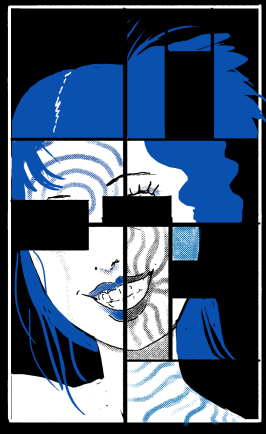
The way things are is not the way they had to be. You can choose, filtering the threads of possibilities and inviting them to meld with the real world.
Fact: CAIN doctrine clearly states the existence of ‘alternate’ realities is currently unproven.
MIMIC (Passive)
You can alter minor things about your appearance. You can change any of the following about yourself when resting, within a variation of your original body:
- Body features such as height and weight.
- Aesthetics such as facial features, skin color, hair, gender presentation.
- Age, down to 13 and up to 88. You always look faintly similar, like a distant relative of yourself.
Your clothes always change to fit you, though you cannot alter them. This doesn’t change anything about your skills or general ability, and also cannot restore missing body parts or hide strain marks or scars.
★ UNIFORM (Charm, Self, Until Rest)
You make a brief edit of yourself. You can’t do this in public (you need privacy, no matter how tenuous). This power makes you officially part of any profession or group with more than 5 members, with any necessary uniform, equipment, id cards, memberships, etc, and alters reality to make it so.
Even if people don’t particularly remember you being part of a group, they may get a vague sense that you were a member.
You don’t actually gain any particular skills and any changes you may have to be to your own person and must include things you could wear or carry in one or both hands.
Gain or grant +1D when you or any ally next acts to take advantage of this power.
★ ABSURD (Curse, Short, Scene)
You swap a CAT amount of humans or executioners with a different version of themselves from an alternate timeline. You must roll MENTAL for this power to take effect on hostile targets, only spending a burst on success. This can change:
- what the target is wearing, but not holding (so anything held in hand remains the same)
- physical appearances of the targets, as your MIMIC power.
Targets retain their memories, and this does not alter reality to accommodate the change, so it can easily disorient unprepared humans. The change is otherwise perfect.
Gain or grant +1D when you or any ally next acts to take advantage of this power.
★ UTILITY (Until Rest, Short)
When you need any mundane object, tool, or vehicle that could fit in a small room, you can cause it to appear on a surface in range as though it was always there, without spending KP. However, the admin chooses one, or two if the item is dangerous or rare:
- The item is used, dented, scuffed, or poor quality.
- The item is a real item that someone nearby owned and has now disappeared, and they will come looking for it.
- The item is ‘off’ somehow and appears as a cheap knockoff made of odd materials that feel spongey or organic.
- The item is missing some parts and doesn’t work as well as it could with them.
The item cannot be a unique item, etc you cannot create a particular car, key, book, etc, but is rather a generic representative of a category. It disappears after a rest.
★ COPY (Summon, Adjacent, Scene)
You create a temporary, exact copy of a human, or executioner.
- This creates a doppelgänger: a simple, obedient clone, without much intelligence or ability to speak.
- You may give it simple instructions of one or two sentences, which it follows to the best of its ability.
- It dissolves into a pale sludge when the scene ends, when touched by anyone except you, or if it takes any harm.
This ability creates a copy of the target in its present state, including anything mundane a person is carrying or wearing. A doppelgänger cannot gain, use, or benefit from psychic powers and rolls just 1d6 to do anything.
★ FILTER (Transmute, Adjacent, Scene)
You produce a strong field affecting all matter in an area about the size of a small room, which must contain you. In this area you gain +1D to examine its contents and:
- You can cause any matter to become transparent or opaque.
- You can change the lighting in the room as though lit by an invisible light source, or snuff out any light sources in the room.
- You can move around any objects in the area without touching them and ‘pin’ them to any point in space in the area, causing them to float.
- You can safely dissect any loose inanimate object or furniture into its constituent parts or reassemble any broken object, providing any parts are present.
This effect expires when the scene ends, or if you leave the area for any reason.